Quality Facilitation Drives Behaviour Change and Real-World Impact.
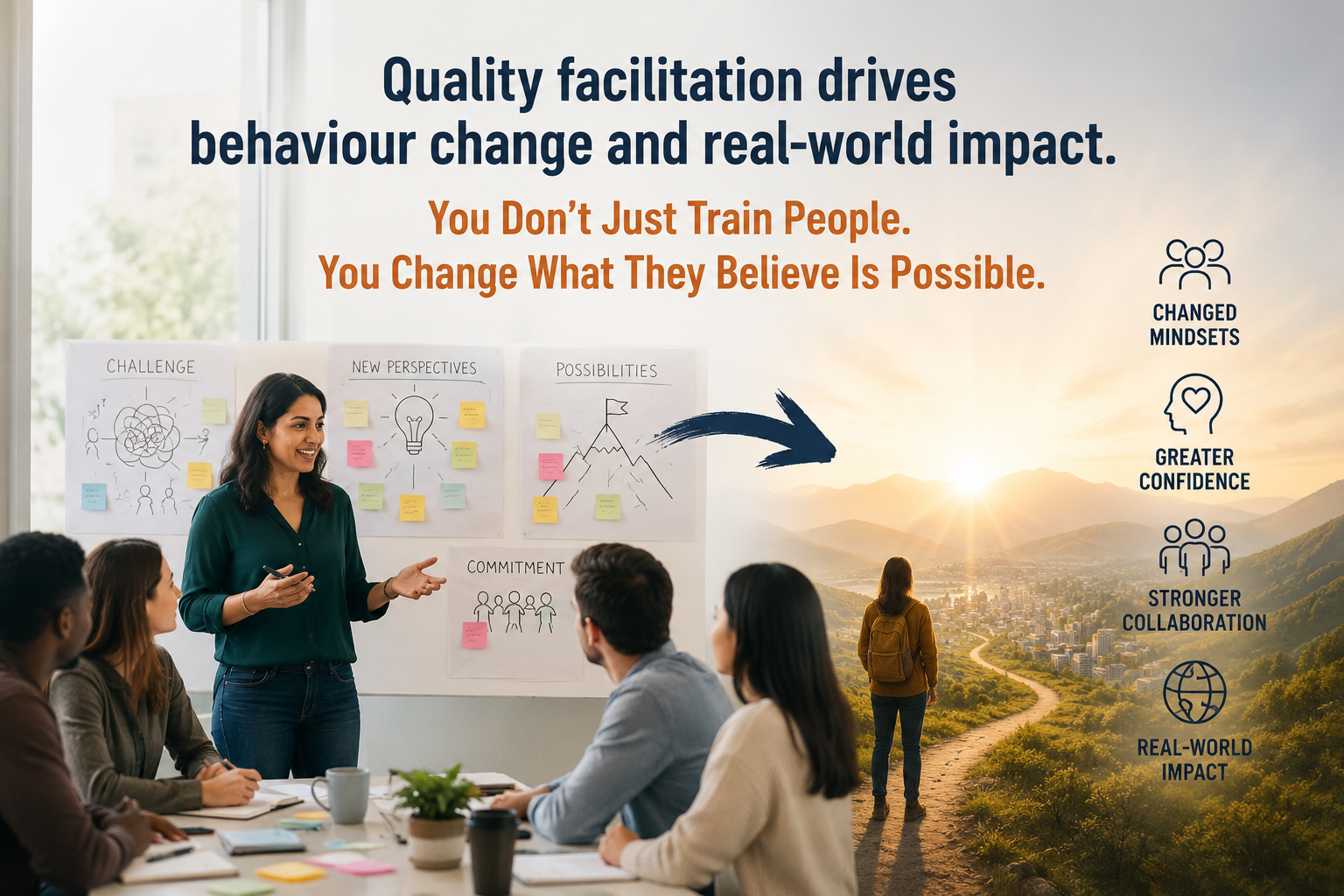
There is a moment every trainer recognizes. It comes near the end of a session, not when you are speaking, but when you stop. When participants begin connecting ideas, challenging assumptions, and seeing new possibilities for themselves.
That moment is where learning becomes change.
As trainers, we often measure success by attendance numbers, training hours, or participant feedback scores. Yet none of these truly tells us whether learning has made a difference. The real question is simpler:
What will people do differently because of this training?
That is where quality facilitation matters most.
The Transfer Gap: Why Training Often Falls Short
Across Africa, organizations invest significant resources in workshops, seminars, and learning programmes. Participants leave with new information, fresh insights, and sometimes even certificates.
Yet many return to work and continue operating exactly as before.
This is what learning professionals call the transfer gap—the distance between what people learn during training and what they actually apply afterwards.
A business owner may attend a financial management workshop and understand the concepts being taught. However, unless that knowledge influences how they manage cash flow, assess risk, or make business decisions, the training has created awareness rather than impact.
Knowledge alone does not drive change. Application does.
For SMEs across Africa, where business decisions directly affect livelihoods, jobs, and economic growth, bridging this gap is critical.
The Facilitator's Real Role
Many trainers view their role as delivering content.
Effective facilitators understand their role differently.
Their responsibility is not simply to teach. It is to create the conditions that help people think differently, make better decisions, and take meaningful action.
Facilitation shifts the focus from what the trainer says to what the learner experiences.
When participants actively engage with ideas, test assumptions, solve problems, and reflect on their own realities, learning becomes more likely to transfer into practice.
This is where real behaviour change begins.
Five Practices That Drive Behaviour Change
Over the years, I have found that effective facilitators consistently focus on a few key practices.
1. Design for the Learners in Front of You
No two groups are identical.
Effective facilitators adapt content to participants' needs, realities, and existing knowledge rather than rigidly following a predetermined script.
2. Make Thinking Visible
Adults learn best when they actively participate.
Less lecturing and more discussion, problem-solving, reflection, and peer learning create stronger ownership of learning.
3. Start with Real Problems
People engage more deeply when learning begins with situations they recognize.
Using practical examples and real-life challenges helps learners connect concepts to their daily decisions.
4. Focus Explicitly on Application
One of the most powerful questions a facilitator can ask is:
"What will you do differently on Monday?"
When learners identify specific actions, the likelihood of transfer increases significantly.
5. Keep Learning as a Professional
The most effective facilitators never stop developing themselves.
Continuous learning, feedback, reflection, and engagement with professional communities help trainers remain relevant and effective.
Why Professional Standards Matter
Creating behaviour change requires more than subject-matter expertise. It requires strong facilitation skills and a deep understanding of how adults learn.
This is why professional development and certification frameworks, such as those supported by IFC and its learning partners, remain important. They help trainers move beyond content delivery and develop the competencies needed to facilitate meaningful learning experiences.
The goal is not certification for its own sake. The goal is better learning outcomes.
A Call to the Profession
Africa does not lack talent, ambition, or entrepreneurial energy.
What often determines success is whether people can translate knowledge into action.
As trainers, our responsibility extends beyond delivering information. We help individuals build confidence, challenge assumptions, and apply new ideas in ways that improve performance and create opportunities.
When learning transfers into action, businesses grow, decisions improve, and communities benefit.
That is the true impact of quality facilitation.
Because we do not just train people.
We change what they believe is possible.
About the Author
Adaora Ayoade is an IFC-Certified Master Trainer in Facilitating Learning and an IFC-LPI TPMA Assessor based in Lagos, Nigeria. She works with financial institutions, development organizations, and SME support providers across Africa to build the high-performing capacity of trainers and learning professionals.